
Startup Funding Stages Explained: From Idea to Series A
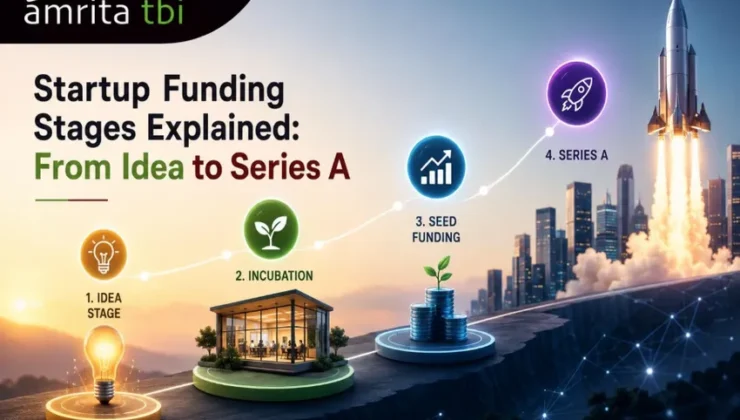
Ask ten founders what “getting funded” means and you’ll get ten different answers, because funding isn’t a single event – it’s a sequence of stages, each with its own purpose, its own investors, and its own definition of “ready.” Most founders learn this the hard way, either by trying to raise the wrong kind of capital too early or by not knowing which door to knock on next.
This piece walks through the major funding stages a startup typically moves through – from a raw idea to a Series A round – and uses Amrita Technology Business Incubator (Amrita TBI) as a working example of how one Indian incubator has built a program for nearly every stage of that journey.
Stage 1: The Idea Stage – Before There’s a Company at All
At this point, there’s often no registered entity, no product, and no revenue – just a founder (or an aspiring one) with a problem worth solving. The biggest obstacle here usually isn’t a lack of ideas; it’s the practical reality that pursuing one full-time is expensive, especially for someone still holding down a job.
This is the stage government-backed fellowship-style programs exist to solve. Amrita TBI’s NIDHI-EIR program – one of only ten centres approved nationally under this NSTEDB initiative – provides a monthly subsistence grant of up to INR 30,000 to an aspiring entrepreneur pursuing a promising technology business idea. It isn’t meant to fund a company; it’s meant to buy a person enough runway to quit a job and validate an idea without going broke in the process.
For hardware and deep-tech ideas specifically, Amrita TBI PRAYAS – backed by NIDHI and the Department of Science and Technology – offers grants of up to INR 10 lakh per recipient (from a total outlay of up to INR 1 crore) to take an idea from concept to a working prototype, with access to the incubator’s Fab Lab for 3D printing, PCB design, IoT tooling, and CNC machining.
What “ready for the next stage” looks like: a validated problem, an early prototype or proof of concept, and enough conviction to formalize the idea as a company.
Stage 2: Incubation – Turning an Idea Into a Company
Incubation is where a founder typically registers a company, builds a first product, and starts testing it with real users. It’s also usually the first stage where meaningful capital enters the picture – not because the startup has proven a business model yet, but because building one requires resources: office space, technical infrastructure, mentorship, and enough runway to get to a real product.
Amrita TBI’s core Incubation program is built for exactly this stage. It can fund a startup with up to INR 1 crore through a mix of loans and equity, channelled through government schemes including the NSTEDB Seed Support System, the DST’s Technology Development Board program, MeitY’s TIDE program, and MSME schemes, alongside the incubator’s own connections into India’s VC ecosystem. Startups also get physical co-working and lab space across Amrita TBI’s Kollam, Bengaluru, and Coimbatore campuses, with access to over 100 multidisciplinary labs, a three-year GST exemption on revenue up to INR 50 lakh annually, and mentorship support.
What “ready for the next stage” looks like: an actual product in the hands of real users, early signs of traction (even if small), and a business model that’s starting to look repeatable.
Stage 3: Seed Funding – Betting on Early Traction
Seed funding is where outside investors – angels, seed funds, and increasingly government-backed schemes – start writing checks based on early traction rather than pure conviction. The startup usually has a product, some paying customers or active users, and a rough sense of what it will take to grow.
In India, one of the more structured ways to access this stage of capital is the Startup India Seed Fund Scheme (SISFS), a DPIIT initiative with an outlay of Rs 945 crore. Amrita TBI is a recognized SISFS partner incubator, meaning it can disburse this scheme’s funding directly: up to Rs 50 lakh for market entry, commercialization, or scaling, and up to Rs 20 lakh as a grant for proof-of-concept validation, prototyping, or product trials. Eligible startups need to be DPIIT-recognized and incorporated within the past two years, among other criteria – but for founders who qualify, it’s a meaningful, non-dilutive-leaning path to seed capital, run through an incubator rather than a faceless government portal.
This stage is also where a startup’s ability to tell a compelling story starts to matter more. That’s precisely what platforms like Amrita TBI PitchFest are built for – a pitch competition connecting founders directly with venture capitalists and C-level executives, offering feedback, mentorship on market penetration, and a total seed investment pool of up to $200,000 for standout teams. It’s less about a single check and more about getting in front of the right people at the moment a startup can actually make its case.
What “ready for the next stage” looks like: consistent, ideally growing revenue or usage; a clearer view of unit economics; and a team that can demonstrate the business works, not just that the idea is good.
Stage 4: Pre-Series A / Acceleration – Getting Fundable, Fast
Between seed and Series A sits a stage that’s less about capital and more about compressing time. A startup at this point usually has a working business but hasn’t yet nailed its go-to-market strategy, refined its business model, or built the pitch and metrics that later-stage investors expect to see. Accelerator programs exist to close that gap quickly – often in a matter of months rather than years.
Amrita TBI’s Accelerator is built specifically for this stage: a fast-paced, cohort-based program pairing founders with mentors from both the Indian startup ecosystem and Silicon Valley, working through business model refinement, customer development, and go-to-market strategy. It culminates in a Demo Day where startups pitch to external investors, backed by Amrita TBI’s own seed investment pool of $100,000 split among the top three startups – on top of whatever the startup raises from the external investor panel present on the day.
The explicit goal of a program like this isn’t just funding – it’s making the startup “fundable-ready,” a distinction that matters. A lot of startups at this stage have a product and some revenue but aren’t yet a company an institutional Series A investor would recognize as investment-ready. Acceleration is where that gap typically gets closed.
What “ready for the next stage” looks like: a repeatable, provable go-to-market motion; clean, defensible metrics; and a business model that can plausibly support the growth a Series A investor is underwriting.
Stage 5: Series A – Institutional Capital Enters
By the time a startup reaches Series A, the questions from investors change. It’s no longer “does this work?” – it’s “can this scale?” Series A investors are typically institutional VCs writing larger checks (commonly in the range of a few million dollars and up in the Indian market) against a business that has proven product-market fit and needs capital specifically to scale distribution, team, or infrastructure.
Incubators generally don’t write Series A checks themselves, but the better ones – Amrita TBI included – stay involved well past their own formal programs, continuing to support portfolio companies as they raise follow-on rounds and connecting them to VC networks built over years of operating in the ecosystem. That continuity is a big part of why Amrita TBI’s portfolio has collectively raised upwards of $330 million in funding to date: the incubator isn’t just a launching pad, it’s a relationship that persists through multiple rounds.
Why the Stage-by-Stage View Matters
The biggest mistake founders make isn’t picking the wrong investor – it’s misjudging which stage they’re actually in. A startup with just an idea trying to raise seed capital will struggle to convince anyone it’s de-risked enough to write a check. A startup with real traction that’s still treating itself like an idea-stage project will leave funding on the table it’s actually qualified for.
What a program stack like Amrita TBI’s illustrates well is that each stage has a different kind of support attached to it – subsistence funding and prototyping grants for the idea stage, structured incubation capital and infrastructure for company formation, seed schemes and pitch platforms for early traction, and accelerator programs to compress the sprint to Series A readiness. Understanding which stage you’re actually in – and which kind of support matches it – is often the difference between a fundraise that goes nowhere and one that moves a company forward.
Amrita TBI operates from Kollam, Bengaluru, and Coimbatore, and runs funding programs spanning the idea stage through pre-Series A acceleration. Program details are available at amritatbi.com.